
Fast Closing
Speed and acceleration
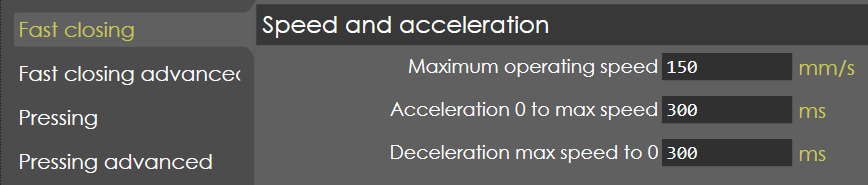
Maximum operating speed
Range |
10-500 |
Default |
150 |
Units |
mm/s |
Access |
Administrator |
Function
This parameter defines the maximum travel speed of the Y-axis during closing.
Description
During fast closing, the height retain valves are opened and the RAM is ready to fall down by its gravity, when the proportional valves are opened. Normally this value should be programmed to the maximum possible speed of the axis, when the control signal is at maximum.
Acceleration 0 to max speed
Range |
0-2000 |
Default |
300 |
Units |
ms |
Access |
Administrator |
Function
This parameter defines the acceleration time of Y-axis during fast closing.
Description
This is the nominal acceleration of the axis, used to control the axis from zero to maximum speed in the closing phase. This parameter must be programmed as the time in which the axis accelerates from zero to maximum speed.
Deceleration max speed to 0
Range |
0-2000 |
Default |
300 |
Units |
ms |
Access |
Administrator |
Function
This parameter defines the deceleration time of Y-axis during fast closing.
Description
This is the nominal deceleration of the axis, used to control the axis from maximum to zero speed when axis comes to its position in the closing phase. This parameter must be programmed as the time in which the axis decelerates from maximum to zero speed.
Gain
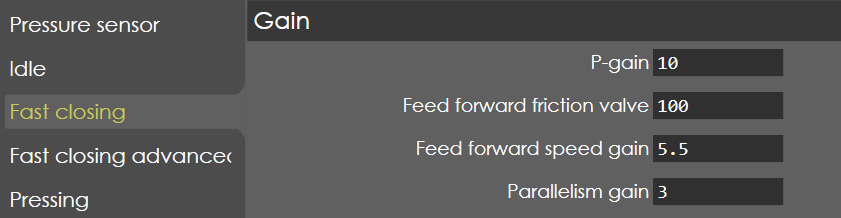
P-gain
Range |
0.1-99.9 |
Default |
10 |
Units |
NA |
Access |
Administrator |
Function
This parameter defines the Proportional gain factor of Y-axis during closing phase.
Description
This gain factor defines the response to changes in the control signal. A high gain gives a quick response, if the gain is too high it will cause oscillation.
Feed forward friction value
Range |
00-999.9 |
Default |
100 |
Units |
NA |
Access |
Service |
Function
This parameter defines the gain factor for braking of Y-axis during closing phase.
Description
To set gain factor for the axis when approaching the programmed position for a quick and smooth approach to mute point.
Feed forward speed gain
Range |
0-999.9 |
Default |
5.5 |
Units |
NA |
Access |
Service |
Function
This parameter defines the gain factor for reducing the lag error of Y-axis during fast closing phase. Thereby the beam follow the computed cycle more accurately.
Description
By increasing this gain the beam will follow the computed cycle more accurately. It is recommended not to set this value too critically. A tracking error between 2 and 4 mm is a good practical value in fast closing phase.
Parallelism gain
Range |
1-1000 |
Default |
3 |
Units |
NA |
Access |
Administrator |
Function
This parameter defines the gain factor for parallelism control of Y-axis during fast closing.
Description
The parallelism during fast closing can be adjusted with this parameter. A higher value will result in a smaller difference between Y1 and Y2 during the movement. In practice this difference should be approximately 0.1 - 0.4 mm.
| Programming this value too high will result in unstable movement of the beam. |
General
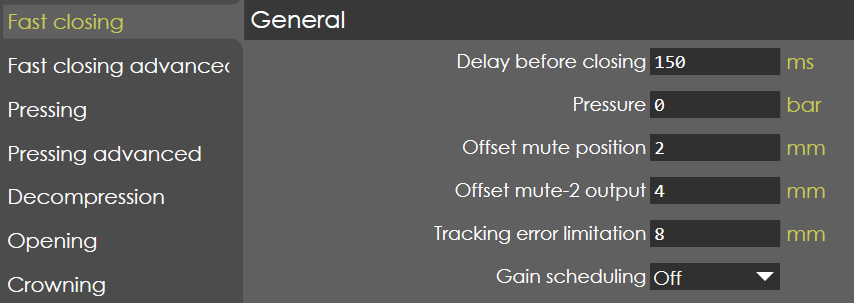
Delay before closing
Range |
1-2000 |
Default |
150 |
Units |
ms |
Access |
Administrator |
Function
This parameter defines the time needed to open the height retaining valves.
Description
When the fast closing command becomes active, the proportional valves will not be opened until this delay time has elapsed, to make sure the synchronized start of beam speed after the opening of height retaining valves on either side.
Pressure
Range |
1-1000 |
Default |
0 |
Units |
Bar |
Access |
Service |
Function
This parameter defines the pressure setting during fast closing phase.
Description
NA
Offset mute position
Range |
-9.99 to 9.99 |
Default |
2 |
Units |
mm |
Access |
Administrator |
Function
This parameter defines the offset on programmed mute position.
Description
Normally, the Mute output becomes active when the RAM reaches the Mute position. The gain factors of fast closing parameters are tuned in such a way that while approaching the Mute position, the RAM slow down and reaches the point. This will take more time to reach the mute position.
In order to decrease the bend cycle time, the braking distance of RAM during fast closing is changed by this parameter value. This way, the beam can approach the mute point faster and can be stopped exactly at the programmed Mute position.
Offset mute-2 output
Range |
-20 to 20 |
Default |
4 |
Units |
mm |
Access |
Service |
Function
This parameter defines the second offset on programmed mute position.
Description
This second mute output can become active before or after the standard mute output. With this parameter the distance between the mute and the second mute output is programmed. This parameter only influences the position at which the second mute output becomes active, it does not influence the mute position or the braking ramp to arrive at mute.
A positive value means the second mute output will become active after the standard mute output. A negative value means the second mute output will become active before the standard mute.
Tracking error limitation
Range |
0-100 |
Default |
8 |
Units |
mm |
Access |
Service |
Function
This parameter defines the maximum allowed difference between the computed position and actual position, during fast closing.
Description
During the fast closing, the controller will try to match the commanded and actual position as accurate as possible. The tracking error also called as lag error, is the difference between the commanded and actual position. The limitation here is the maximum tracking error allowed during fast closing.
Gain scheduling
Range |
ON/OFF |
Default |
OFF |
Units |
NA |
Access |
Administrator |
Function
This parameter enables/disables the gain scheduling function.
Description
Generally, the gain factor parameters of fast closing are tuned with the maximum open height distance to get a smooth profile of axis motion. When the fast closing distance are less, still the same gain factors are valid, but the motion may not be smooth. By activating this function, the gain factors are dynamically changed with respect to distance to get better motion profiles.